
New Jersey Homeowner Guide
Critter Guard Installation for Solar Panels in New Jersey
Squirrels and birds nesting under your array chew wiring, trap debris and take systems offline. Here is what critter guard costs in New Jersey, how it is installed without touching your panel or roof warranty, and when it pays for itself.
What does critter guard cost in New Jersey?
Most New Jersey homes land between $750 and $2,200, because critter guard is priced by the linear footage of array perimeter rather than by panel count. Cleanout of an existing nest and any chewed-wire repair are quoted separately so you can see exactly what you are paying for.
| Scope of work | Typical range |
|---|---|
| Critter guard installation, per linear footMesh, clips and labor. Measured around the full perimeter of each array section. | $8 – $14 |
| Typical small array (10–14 panels)One or two roof planes, standard asphalt shingle roof, straightforward access. | $750 – $1,400 |
| Typical mid-size array (15–25 panels)Most New Jersey homes land in this range depending on perimeter and roof planes. | $1,200 – $2,200 |
| Large or multi-plane array (26+ panels)More perimeter, more staging, and often multiple roof faces and pitches. | $2,000 – $3,500 |
| Nest removal and under-array cleanoutRemoving nesting material and debris before the guard goes on. Priced by severity. | $250 – $700 |
| Chewed wire / conduit repairReplacing damaged DC leads, MC4 connectors, or conduit chewed by rodents. | $350 – $1,400 |
| Microinverter or optimizer replacement after damageWhen rodent damage takes out module-level electronics along with the wiring. | $275 – $550 per unit |
| Guard install bundled with a removal & reinstallBy far the cheapest time to add it — the crew and staging are already on the roof. | Add $400 – $900 |
Ranges are typical New Jersey residential pricing and are not a quote. We measure your array and give you a flat written price before any work begins.
Why critter guard matters
Squirrels chew wiring
The gap under your panels is a dry, sheltered, predator-free ledge. Squirrels nest there and chew DC leads and connectors, which causes arc faults, dead strings, and offline microinverters.
Birds nest and pack debris
Pigeons and starlings fill the under-array space with nesting material. That traps heat, holds moisture against the roof deck, and blocks water from draining off the shingles.
Droppings and staining
Nesting brings droppings down the roof face and onto panel edges. Beyond the mess on siding and gutters, soiling on the lower panel edge measurably cuts production.
Roof and shingle damage
Trapped debris and standing moisture shorten shingle life and can lead to leaks around mounting penetrations — a far more expensive repair than a guard.
Fire and safety risk
Chewed insulation on live DC conductors is a genuine arc-fault and fire risk. This is the reason we treat rodent damage as urgent rather than cosmetic.
Lost production and SREC value
A dead string from a chewed wire is lost kilowatt-hours and lost New Jersey incentive value every day it stays offline.
Signs you already have critters under your array
- Scratching, scurrying or chewing sounds coming from the roof, especially at dawn and dusk
- Nesting material, twigs, leaves or insulation visible at the edges under your panels
- Droppings or staining on the roof, gutters, siding or lower panel edges
- One panel, one string, or the whole system suddenly stopped reporting
- Arc-fault or ground-fault errors in your Enphase or SolarEdge app
- Visible wiring hanging below the array instead of being clipped up
If your system has already gone offline, start with our NJ solar repair cost guide.
What drives the price
Array perimeter, not panel count
Critter guard is priced by the linear footage that has to be enclosed. Two arrays of the same panel count can differ a lot depending on layout — a long single row costs more to guard than a tight rectangle.
Number of roof planes
Each separate array section has its own perimeter and its own staging. Three small sections cost more than one large section with the same panel count.
Roof pitch, height and material
Steep pitches, three-story homes, and tile or slate roofs all add safety setup and labor. Standard shingle roofs are the fastest.
Guard material
We use PVC-coated galvanized steel mesh with UV-stable clips that grip the module frame — no roof penetrations, no drilling into your panels. Cheap plastic mesh fails in a couple of New Jersey winters.
Existing infestation
If animals are already living under the array, nests must come out and the area must be cleaned before the guard goes on. Sealing animals in is not an option.
Damage found during install
Once we can see under the array we often find chewed leads or connectors. We document it, quote the repair separately, and fix it while we are already up there.
Bundling with other work
Adding a guard during a roof-replacement removal and reinstall, a repair visit, or a maintenance service saves most of the mobilization cost.
How the installation works
1. Inspection and measurement
We inspect the array perimeter and the space beneath it, look for entry points and existing damage, and measure the exact linear footage to be guarded.
2. Written flat-rate quote
You get the guard price plus any nest removal or wiring repair itemized separately, before work starts. No per-hour surprises.
3. Cleanout and nest removal
Nesting material and debris come out first. Where needed we lift modules to reach packed sections, then clear the roof surface underneath.
4. Wiring inspection
With access open, we check DC leads, MC4 connectors, conduit and rapid-shutdown devices for chew damage and report anything found.
5. Guard installation
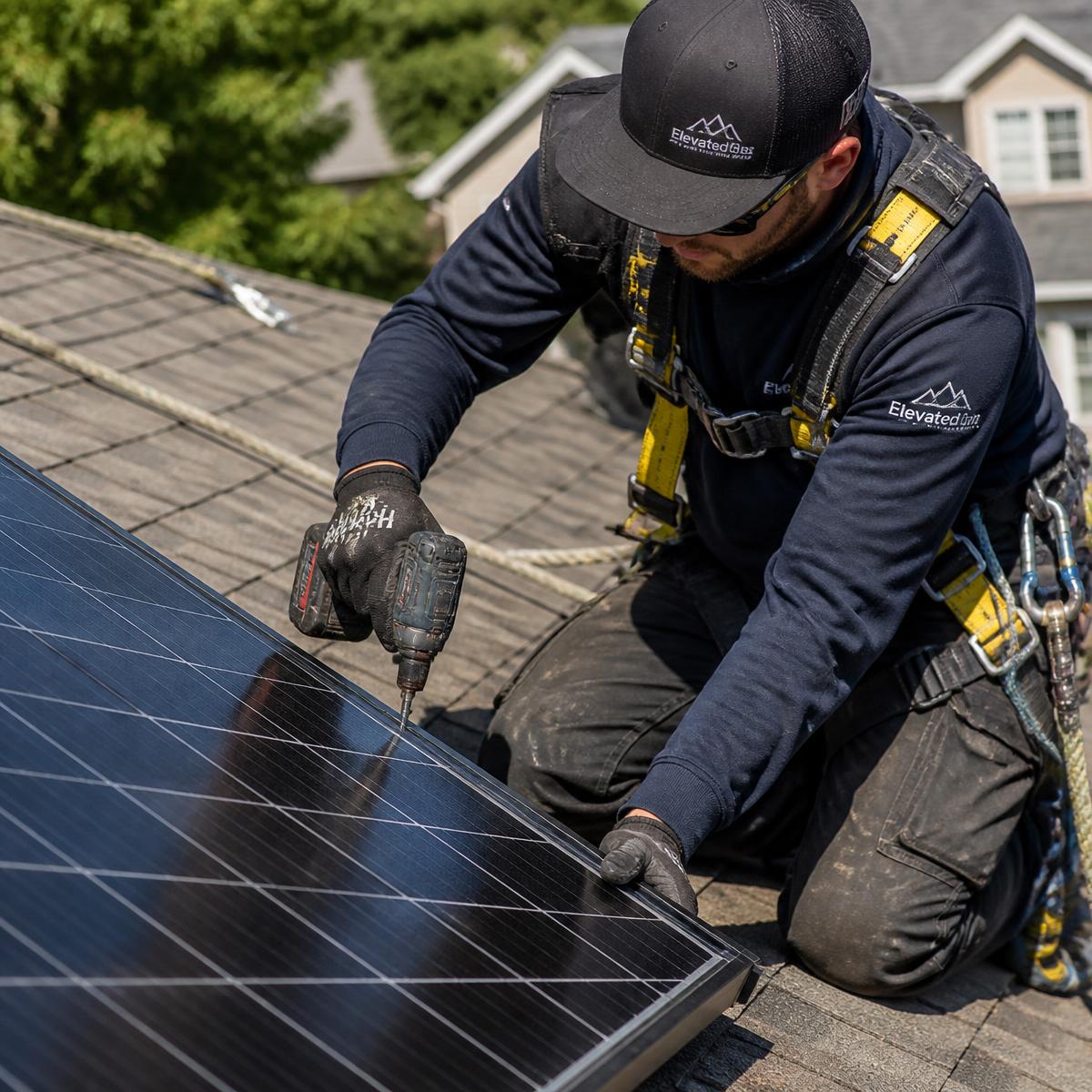
PVC-coated mesh is cut to the array profile and secured to the module frames with stainless clips. Nothing is screwed into the roof and nothing penetrates the panels or their warranty.
6. Cleanup and verification
We clear the roof and grounds, confirm the perimeter is fully closed with no gaps at valleys or corners, and verify the system is reporting normally before we leave.
New Jersey specifics
New Jersey has serious squirrel pressure
Dense mature tree cover across Monmouth, Middlesex, Mercer, Somerset and Bergen counties puts gray squirrels on almost every roof. This is one of the most common service calls we get.
Fall is peak nesting season
Squirrels look for winter shelter from late summer through November. Guards installed before fall prevent the problem instead of paying to fix it.
Shore-area corrosion
Near the coast, salt air destroys bare or cheaply coated mesh. PVC-coated galvanized steel with stainless clips is the only material that holds up here.
Do it with your reroof
If a roof replacement is coming, the panels are already coming off. Adding the guard at reinstall is the lowest-cost way to get it done.
Most warranties are unaffected
Clip-mounted guards do not drill panels, rails, or roofing, so panel and roof warranties stay intact. Rodent damage, on the other hand, is often excluded from coverage.
Planning a roof replacement? Bundle the guard with your panel removal & reinstallation so the panels only come off once.
Critter guard FAQs
How much does critter guard installation cost in New Jersey?
Most New Jersey critter guard installations run $750 to $2,200, priced at roughly $8 to $14 per linear foot of array perimeter. Larger multi-plane arrays run $2,000 to $3,500. Nest removal and any chewed-wire repairs are quoted separately.
Is critter guard worth it?
Yes, in almost every wooded New Jersey neighborhood. A guard typically costs less than a single rodent-damage repair, and rodent damage is frequently excluded from insurance and warranty coverage.
Will critter guard damage my panels or void my warranty?
No. We use clips that grip the module frame rather than drilling panels, rails or roofing, so panel, mounting and roof warranties are unaffected.
How long does the install take?
Most residential arrays are completed in a single visit of three to six hours. Heavy nest cleanout or discovered wiring damage can extend it, and we tell you before we proceed.
Can you install critter guard on a system another company installed?
Yes. Most of our critter guard work is on systems installed by other companies, including installers that are no longer in business.
What if animals have already chewed my wiring?
We inspect the DC leads, connectors and conduit during the install, document what we find, and quote the repair separately. Fixing it while we are already on the roof saves a second mobilization.
Does critter guard block airflow or reduce production?
No. Open mesh keeps airflow and cooling under the modules intact. In practice production usually improves, because debris and droppings no longer accumulate on the lower panel edges.
What areas do you serve?
Covering all of New Jersey. We handle critter guard installation, solar repair, maintenance and removal and reinstallation statewide.
Keep the critters out before they cost you a repair.
Free measurement, flat written pricing, PVC-coated steel mesh, and no drilling into your panels or roof. Covering all of New Jersey.